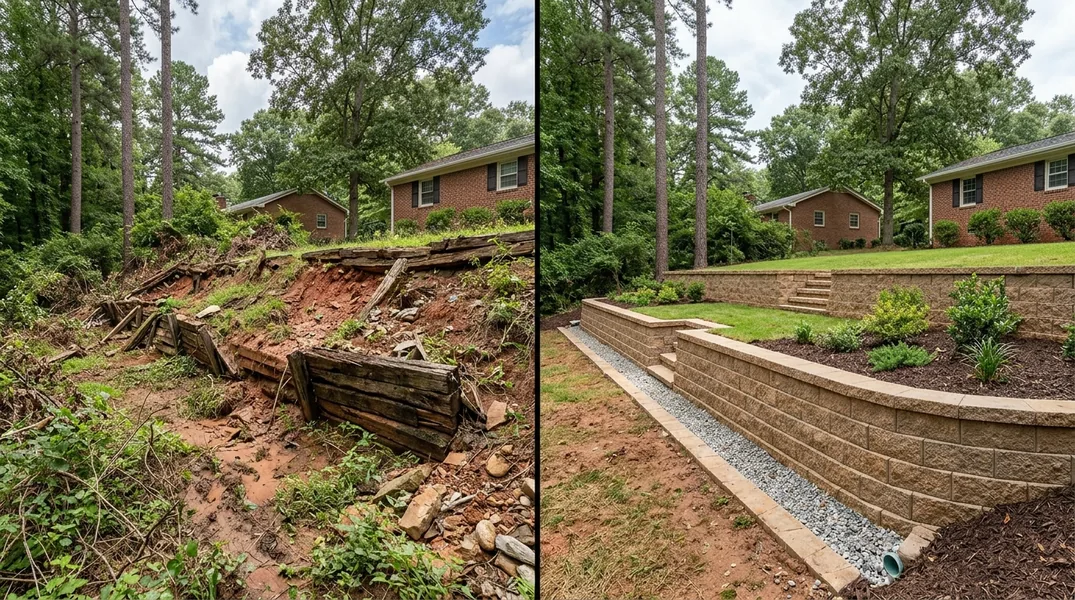
Why Raleigh's Red Clay Is So Hard on Retaining Walls
If you live in Raleigh, you already know the soil in your yard is not like the sandy loam you see on home improvement shows. The Piedmont region is famous for its dense red clay, and while it grows beautiful trees and shrubs, it behaves very differently from other soils when it comes to supporting structures. Clay particles are tiny and flat, which means they pack together tightly but also hold onto water. When it rains, that clay absorbs moisture and expands. When it dries out in the summer heat, it shrinks and cracks. This constant cycle of swelling and shrinking puts enormous pressure on anything buried in or resting against it, including your retaining wall.
Most retaining wall failures in the area start with water management, not with the blocks themselves. A wall that was built without proper drainage allows water to build up behind it. The saturated clay becomes incredibly heavy, and the hydrostatic pressure pushes outward against the wall face. Over time, even a well-built wall can begin to lean or bow if the drainage system clogs or was never installed correctly. Understanding this clay behavior is the first step toward protecting your investment and knowing when to call for Retaining Wall Repair.
The Most Common Reasons Retaining Walls Fail in Raleigh
Beyond the soil itself, there are several construction and environmental factors that lead to a failing retaining wall. One of the biggest culprits is inadequate footing depth. In Raleigh, the freeze-thaw cycle is mild compared to northern states, but it still happens, and a footing that is too shallow can shift as the ground moves. Another common issue is backfill material. If a contractor used the native red clay as backfill instead of gravel or crushed stone, the wall is essentially fighting a losing battle against expansion and poor drainage. Proper backfill allows water to flow freely to the drain pipe rather than saturating the soil behind the wall.
Tree roots are another frequent problem. Raleigh's mature oak and pine trees have aggressive root systems that can invade the wall's drainage zone, crack concrete, and displace blocks. Even the weight of heavy landscaping or a patio built too close to the wall's edge can add surcharge pressure that the wall was never designed to handle. Finally, age and lack of maintenance take their toll. Small cracks and joint separations that seem minor can let water in, and once water gets behind the wall face, the freeze-thaw cycle widens those gaps season after season. Recognizing these root causes helps homeowners ask the right questions when evaluating a Retaining Wall Installation contractor or planning repairs.
Warning Signs: How to Spot a Leaning or Bowing Retaining Wall
A retaining wall rarely collapses without warning. It gives you clues, sometimes for years, before a major failure occurs. The most obvious sign is a leaning retaining wall. Step back and look at the wall from the end or from a corner. Does the top of the wall lean outward toward the street or yard? Even a slight tilt is a red flag, because walls are designed to stand plumb or lean slightly into the hillside, never away from it. Another clear warning is bowing. If you place a straight edge or a level against the wall face and see a curve or bulge, the wall is under stress and may need a bowing retaining wall fix before the problem worsens.
Other signs are easier to miss but equally important. Look for stair-step cracks in block walls, where the joints between blocks have separated and shifted. Check for horizontal cracks in concrete walls, which can indicate the wall is bending under pressure. Bulging soil at the base, water pooling behind the wall, or muddy runoff after rain all point to drainage failure. You might also notice doors or gates near the wall sticking, or fence posts that have shifted, which suggests the ground around the wall is moving. If you see any of these signs, it is worth getting a professional opinion sooner rather than later. A small repair today is almost always cheaper than a full Retaining Wall Replacement down the road.
Retaining Wall Repair Near Me: When to Call a Professional
Some homeowners in Cary and Apex wonder whether they can handle a small wall repair themselves. For minor cosmetic issues, such as replacing a single cracked cap or re-pointing a small joint, a handy homeowner can sometimes manage. But structural problems like leaning, bowing, or settling require an understanding of soil mechanics, drainage, and load distribution that goes beyond general handyman skills. A wall that is already showing movement needs to be evaluated for footing condition, drainage performance, and the actual cause of the failure. Repairing the symptom without fixing the cause almost guarantees the problem will return.
Calling a professional is especially important when the wall is taller than about three feet, holds up a driveway or structure, or sits near a property line. In these cases, an improper repair can create a safety hazard or even affect your homeowner's insurance. A qualified contractor will inspect the wall, identify the failure mechanism, and recommend the least invasive repair that will actually last. If you are unsure whether your wall needs attention, it is worth scheduling a free estimate to get an expert opinion. You can also call Raleigh Retaining Wall at (984) 789-5415 to discuss what you are seeing.
How to Prevent Retaining Wall Failure on Red Clay
Prevention starts with proper design and installation. A wall built for Raleigh's clay soil should include a gravel backfill zone, a perforated drain pipe at the base, and a filter fabric to keep clay particles from clogging the drainage system. The footing must be deep enough and wide enough to support the wall's weight and resist soil movement. For taller walls or those holding significant loads, engineered designs using Concrete Retaining Walls or reinforced block systems offer much greater resistance to clay pressure than simple stacked-block walls. Proper compaction of the soil beneath and behind the wall is also critical, and it is one of the most commonly skipped steps in low-bid installations.
Once a wall is in place, simple maintenance goes a long way. Keep an eye on the drainage outlets and make sure they stay clear of debris and roots. Avoid planting large trees or shrubs too close to the wall, and do not add heavy fill or structures on top of the retained soil without consulting a professional. After heavy storms, take a quick walk around the wall and look for new cracks, movement, or soggy areas. If you live in Wake Forest or anywhere in the Raleigh area and want to know what a proper installation looks like, or if you are budgeting for a future project, reviewing current pricing can help you plan. The best defense against a failing retaining wall is a wall that was built right the first time, and that starts with choosing an experienced local contractor who understands red clay.
Looking for a professional retaining wall contractor in Raleigh? Raleigh Retaining Wall responds fast for all your retaining wall needs.
Get a Free QuoteOur services: Retaining Wall Installation · Retaining Wall Repair · Retaining Wall Replacement