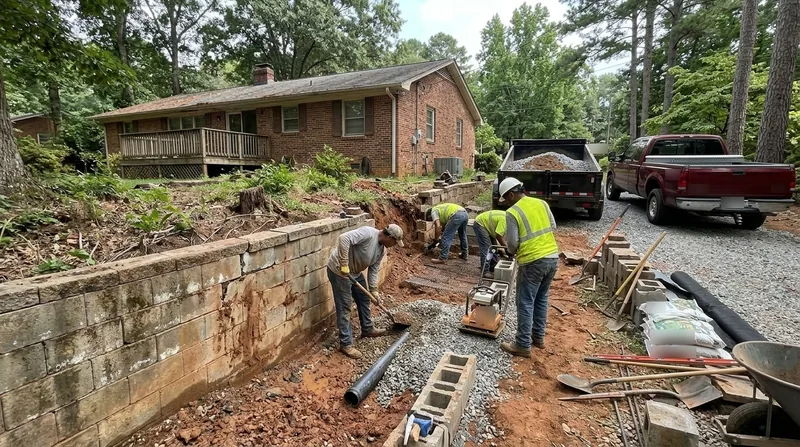




Retaining Wall Repair in Raleigh: Stop a Failing Wall Before It Costs You More
Raleigh sits where the rolling upland clay belt meets the sandier Coastal Plain, and that geology is exactly why so many walls here start to lean. West and north of downtown you get sticky red clay over weathered granite saprolite. Toward Johnston County the ground loosens into sandy loam. Creek valleys like Crabtree, Walnut and House Creek cut through both, and every one of those slopes moves water. If your wall is bowing, cracking or settling, Retaining Wall Repair in Raleigh is the call that keeps a $4,000 fix from turning into a $20,000 rebuild. We work the clay, the pines and the old neighborhood lots every week. For walls that are already past saving, see our retaining wall replacement service.
Why Raleigh Walls Fail: Red Clay, Loblolly Pines and 1920s Lots
The dominant failure mode in Raleigh is not frost and it is not coastal salt. It is clay that soaks up summer thunderstorms and hurricane rain with no drainage behind the wall, then shrinks hard in drought. That wet-dry cycle pushes a wall out at the top and pulls it back at the base until the block courses separate. Add mature loblolly pines whose roots lift and heave shallow footings, and you get the leaning walls we see from Five Points to North Raleigh.
- Water pressure builds behind a wall with no gravel drain or weep holes, and the face bows outward.
- Clay soil settles under the footing after a wet spring, and the top course drops and cracks.
- Tree roots from older oaks and pines push against the back of the wall and shear the block joints.
- Railroad tie and timber walls from 1980s and 1990s subdivisions in Cary and Garner rot at the soil line and lose all holding power.
- Original builders skipped geogrid and compacted fill, so a tall segmental wall in Apex or Holly Springs bulges within a decade.
Most of these problems are repairable if you catch them while the wall is still standing and the soil behind it is still where it belongs.
Key info: A brick garden wall in Hayes Barton that has leaned for two seasons is usually a drainage and footing repair. The same lean on a 6 foot segmental wall holding up a Wake Forest driveway is a structural emergency. We tell you which one you have before you spend a dollar.
Before you authorize any work, confirm what your local building department requires. The City of Raleigh publishes permit guidance through its permitting portal, and thresholds vary by jurisdiction for walls above roughly 4 feet or walls that carry a surcharge.
How We Diagnose and Repair a Leaning Wall on a Raleigh Clay Slope
We start by finding out why the wall moved, because patching the face without fixing the cause just buys you eighteen months. On a clay slope we probe the soil behind the wall, check the footing depth, and look for the water path that is feeding the failure. Then we build the repair around that answer.
- We dig a test pit behind the wall to read soil moisture, footing depth and whether any drainage stone was ever installed.
- We photograph and mark every crack, bulge and settled course so you can see the movement we are correcting.
- We relieve the pressure first, either by restoring the gravel drain and outlet or by adding weep points through the face.
- We re-seat and re-anchor the wall, using tieback anchors on taller walls and partial rebuilds where courses have separated.
- We rebuild the drainage layer with washed stone and filter fabric, then compact the backfill in lifts instead of dumping it in.
- We walk the finished wall with you and show you what to watch for in the next wet season.
Every repair ends with a drainage correction, because a Raleigh wall that still holds water will fail again no matter how well we reset the block.
Key info: On a Boylan Heights wall stepping down toward the rail yards, the top two courses had pushed out almost 3 inches after a wet August. We reset the courses, cut new weep holes and tied the wall back into the slope. The homeowner avoided a full rebuild and the wall has held through two hurricane seasons.
If the movement is severe or a section has already come down, go straight to our leaning and collapsed wall repair page so we can triage it fast.
Repair Approaches We Use Across Raleigh
Not every failing wall needs the same fix. A rotting timber wall in a 1990s Garner subdivision and a cracked poured concrete wall in a North Raleigh ranch call for different tools, and we pick the approach that matches the wall, the soil and the load above it.
| Approach | Description | Best for |
|---|---|---|
| Drainage correction | Restore gravel backfill, filter fabric, weep holes and a daylighted outlet so water stops loading the wall. | Walls that bow only after heavy rain and have no visible drain. |
| Tieback anchoring | Helical or grouted anchors driven back into stable clay and connected to the wall face to pull it plumb. | Tall segmental walls with room behind them and no room to rebuild. |
| Partial rebuild | Remove and reset the failed courses, re-compact the base and reinstall geogrid where it was missing. | Localized collapse, settled tops or separated block joints. |
| Timber and tie replacement | Pull rotting timbers and railroad ties and reset the wall in block or stone that will not decay. | 1980s and 1990s landscape walls in Cary, Garner and Knightdale. |
| Footing and base repair | Underpin or replace a settled footing and re-level the base course on compacted stone. | Walls that dropped after clay settlement or root heave. |
We match the repair to the failure, and we tell you when a repair is throwing money at a wall that should come down.
Retaining Wall Repair Cost in Raleigh: What to Expect
Most retaining wall repair in Raleigh starts from $1,500, and that figure covers a real repair, not a patch. A drainage correction with new weep holes and a cleared outlet sits near that floor. Tieback anchoring on a taller wall, a partial rebuild of several courses, or a timber wall replacement climbs from there. The number moves with wall height, how much soil has to be dug out, access for a mini excavator, and whether the wall carries a driveway or a structure above it.
Two things drive cost up fast in this market. First, access. A wall behind a Five Points house with a narrow side yard takes more hand digging and more labor hours than the same wall on an open Apex lot. Second, hidden damage. We do not know how far the footing has settled until we open it up, and we price that honestly instead of lowballing and adding change orders later.
Get two or three written estimates and compare what each one actually includes. A quote that skips the drainage correction is not cheaper, it just moves the cost to next spring. Our full pricing overview breaks down how we build a number.
Key info: A homeowner in Holly Springs was quoted a full replacement on a bulging block wall. We repaired the drainage, reset four courses and anchored the top, and the repair came in well under half the replacement price. Not every wall needs to come down.
Retaining Wall Repair Near Me: How to Hire in the Raleigh Area
You will find plenty of names when you search for retaining wall repair near me in Raleigh, and the difference between them shows up two years later. Ask for the license and insurance certificate before work starts, not after. Ask how they handle permits if your wall sits near a property line or above the local height threshold. And ask for references on walls like yours, on clay, not on sand.
- Confirm the contractor is fully insured, and ask for the certificate by email.
- Get at least two written estimates that itemize drainage, anchoring and backfill separately.
- Ask for two or three local references and call them, especially on walls more than 4 feet tall.
- Check whether your HOA or the City of Raleigh requires a permit or engineered drawings for your wall height.
- Make sure the estimate states who pulls the permit and who is responsible for utility locates.
If a contractor will not put the drainage scope in writing, keep looking. That is the part that decides whether the repair lasts.
Ready to get a real number on your wall? Reach out through our contact page and we will set up a free on-site estimate.
Retaining Wall Repair in Raleigh: Pricing Guide
| Service | Price | Details |
|---|---|---|
| Drainage correction and weep hole repair | Starting at $1,500 | Includes clearing the outlet, restoring gravel backfill and cutting new weep points through the face. |
| Partial rebuild of failed courses | Starting at $2,800 | Resets separated block, re-compacts the base and reinstalls geogrid where the original build skipped it. |
| Tieback anchoring on a tall wall | Starting at $4,500 | Helical or grouted anchors driven into stable clay, priced by wall height and anchor count. |
| Timber or railroad tie wall conversion | On estimate | Rot depth, wall length and access decide the scope, so we look on site before quoting. |
| Travel | Included | In Raleigh and surrounding areas, no separate call-out or mileage fee. |
| Estimate | Free | Response within 24 hours at (984) 789-5415, no obligation to book the repair. |
Indicative pricing, the exact cost depends on square footage, finish, and site access. Free personalized estimate within 24h at (984) 789-5415.


