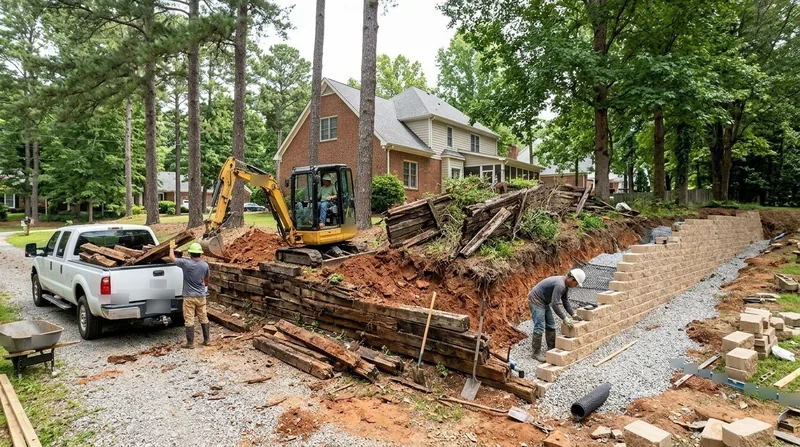




Raleigh sits where the rolling upland clay belt meets the sandier Coastal Plain, and that geology decides how long a retaining wall lasts. West and north of downtown you hit sticky red clay over weathered granite saprolite. Toward Johnston County the ground loosens into sandy loam. Creek valleys like Crabtree, Walnut and House Creek cut through all of it. Retaining Wall Replacement in Raleigh is mostly a story about water: clay soaks up summer thunderstorms and hurricane rain, swells, then shrinks hard in drought. Old timber and railroad tie walls in 1980s and 1990s subdivisions from Cary to Garner rot from the back face out, and brick garden walls in Hayes Barton and Five Points crack when the clay moves under them. We tear out failed walls, haul the debris, and rebuild on drainage that actually works in this ground. If your wall is still standing but leaning, start with retaining wall repair before replacement becomes the only option.
Why Walls Fail in Raleigh's Clay Belt
The dominant failure mode here is water pressure behind the wall, not age alone. A wall built without gravel backfill and a drain pipe turns into a dam. When a two inch rainstorm hits Crabtree Creek clay, the soil behind the wall gains weight fast. The wall face bulges, the top courses kick out, and in bad cases the whole thing rotates forward overnight. In newer cut and fill neighborhoods in Apex, Holly Springs and Wake Forest, tall segmental block walls fail at the base because the footing was never dug below the frost and shrink-swell zone. Timber walls from the 1980s and 1990s are a separate problem: the wood itself is gone, and no amount of patching brings it back.
- Rotting landscape timber and railroad tie walls need full tear-out, not new boards nailed over old rot.
- Clay backfill without drainage fabric and gravel pushes walls out within a few wet seasons.
- Tree roots from tall loblolly pines heave footings and crack mortar joints in older brick walls.
- Erosion at the wall toe undercuts the base, especially on slopes above creek valleys.
- Original builders often skipped permits and engineering, so the wall was undersized from day one.
Every one of these problems gets worse with each wet winter, so the cheapest replacement is the one you schedule before the wall falls.
Key info: A Boylan Heights homeowner called us about a 1920s fieldstone wall stepping down toward the rail yards. The wall had no drainage and the clay behind it had pushed the face out four inches. We documented the lean, pulled the old stone, and rebuilt with a gravel drainage core and a new footing. That is a replacement, not a repair.
Permits matter here. Many Wake County jurisdictions require a permit for walls above roughly 4 feet measured from the footing, or when the wall carries a surcharge like a driveway or structure. Tall or tiered walls often need engineered drawings. Verify the current thresholds with the City of Raleigh building department before you dig.
How We Replace a Wall in Raleigh, Step by Step
Replacement is a demolition job first and a construction job second. We walk the site, check the slope above and below the wall, and look at where the water goes during a storm. Then we plan access for the excavator and the dump trailer, because tight lots in Five Points and Oakwood change the whole schedule. We do not build a new wall on top of the old footing, and we do not reuse backfill that is saturated clay.
- We document the existing wall, the lean, and any structural damage for the permit file.
- We call for utility locates and protect trees and structures within the work zone.
- We demolish the old wall and haul away timber, block, concrete or stone debris.
- We excavate to the new footing depth and shape the subgrade for drainage.
- We install gravel, filter fabric and perforated drain pipe daylighted to a safe outlet.
- We build the new wall in engineered lifts and compact the backfill as we go.
- We restore the grade, seed or sod the disturbed ground, and walk the finished wall with you.
The drainage step is the one that decides whether the new wall lasts thirty years or five.
Key info: In a 1990s Garner subdivision, a homeowner had a 60 foot railroad tie wall holding up the back lawn. The ties were soft enough to push a screwdriver through. We tore it out, rebuilt with segmental block on a compacted gravel base, and tied the drain line into the yard storm system. See the railroad tie wall replacement page for that scope.
Replacement Methods We Use on Raleigh Ground
Not every failed wall should be rebuilt the same way. The right method depends on height, surcharge, soil, access and what the homeowner wants to look at for the next few decades. Here is how we match the approach to the site.
| Approach | Description | Best for |
|---|---|---|
| Segmental block replacement | Engineered block units on a compacted gravel base with a drainage core and geogrid in taller walls. | Tall subdivision walls in Apex, Holly Springs and Wake Forest. |
| Poured concrete replacement | Steel reinforced concrete wall cast on a new footing, with formed joints and a waterproofed back face. | Walls carrying a driveway or structure surcharge. |
| Boulder and natural stone rebuild | New stone set on a rebuilt footing with gravel drainage behind the face. | Garden walls in Hayes Barton, Five Points and Oakwood. |
| Timber and tie tear-out | Full removal of rotted wood, new drainage, and a modern material in its place. | 1980s and 1990s landscape walls in Cary and Garner. |
| Tiered and terraced rebuild | Multiple shorter walls with engineered setbacks and separate drains at each tier. | Steep lots where one tall wall is not permitted. |
We pick the method after we see the soil and the water, not before. If you are still in the planning stage rather than the replacement stage, the retaining wall installation page covers new builds from scratch.
Retaining Wall Replacement Cost in Raleigh: What to Expect
Most replacements in Raleigh start around From $35 per square foot of wall face, and that figure covers demolition, haul-away, new drainage and the new wall itself. Real jobs land above that number for a reason: a wall in a tight Five Points backyard means hand demolition and small equipment, while a straight run behind a Garner ranch house lets a machine do the work. Height adds cost because taller walls need geogrid, engineering and bigger footings. Surcharges, like a driveway or a shed sitting on top of the wall, push it higher again. Railroad tie and timber tear-outs can run more per foot than the original wall cost to build, because the old wood has to come out by the truckload.
We recommend getting two or three written estimates on any replacement over a few thousand dollars. Ask each contractor what is included for drainage, disposal and permits, because a low bid that skips the drain pipe is not a real comparison. Our pricing page breaks down the line items so you can compare bids apples to apples.
Choosing a Retaining Wall Replacement Contractor Near Me in Raleigh
Retaining wall replacement is structural work, so the contractor you hire should carry a license and liability insurance, and be able to show you a certificate before work starts. Ask for references from jobs in Raleigh or a neighboring town and call them. Ask who pulls the permit and who pays if an inspection fails. In older neighborhoods, ask how the contractor will protect mature trees and how they handle a wall close to the property line. If you live under an HOA, get the architectural approval in writing before demolition day, because replacing a wall with a different material can violate the covenant.
- Confirm the license and insurance certificate in writing before signing anything.
- Get two or three itemized estimates that separate demolition, drainage and materials.
- Ask for local references and photos of completed replacements on similar slopes.
- Verify who handles the permit and any engineering drawings the city requires.
- Check HOA rules on wall height, material and color before the old wall comes down.
When you are ready to talk through your wall, contact us for a free estimate and we will walk the site with you.
Retaining Wall Replacement in Raleigh: Pricing Guide
| Service | Price | Details |
|---|---|---|
| Timber and railroad tie replacement | Starting at $35/sq ft | Includes tear-out, haul-away, new drainage and a modern wall in place of the rotted wood. |
| Segmental block replacement | Starting at $42/sq ft | Engineered block, gravel base, drainage core and geogrid on walls above four feet. |
| Poured concrete replacement | Starting at $50/sq ft | New footing, steel reinforcement and waterproofed back face for walls under a surcharge. |
| Boulder and natural stone rebuild | Starting at $55/sq ft | Hand-set stone on a rebuilt footing with gravel drainage, priced by stone size and access. |
| Tiered or engineered wall | On estimate | Needs an on-site look for engineering, setbacks, soil and equipment access before a number. |
| Travel | Included | In Raleigh and surrounding areas, no separate call-out or mileage fee. |
| Estimate | Free | Response within 24h at (984) 789-5415, no obligation to book. |
Indicative pricing, the exact cost depends on square footage, finish, and site access. Free personalized estimate within 24h at (984) 789-5415.


