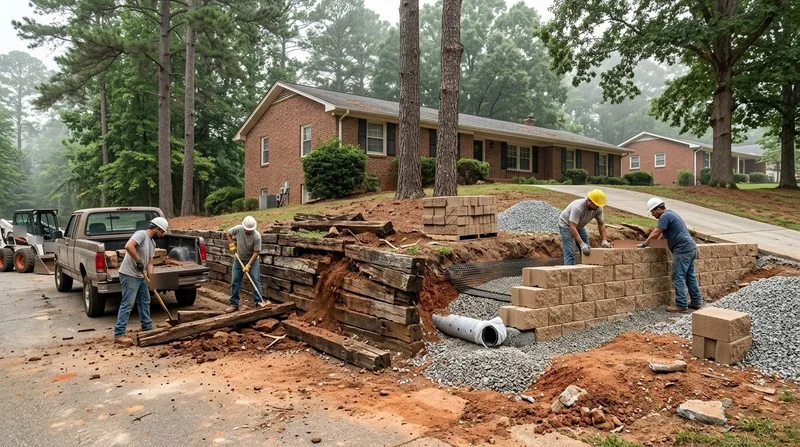




Railroad tie wall replacement in Raleigh is the work we do most on 1980s and 1990s subdivision lots, where creosote-soaked ties have been quietly rotting behind the same shrubs for thirty years. Raleigh sits where the rolling upland clay belt meets the sandier Coastal Plain, so a wall in Five Points may be holding back sticky red clay over saprolite while a wall in Garner sits in looser sandy loam. Both fail the same way: summer thunderstorms and hurricane rain soak the clay, the ties hold water against the soil, and drought shrinks it back until the wall leans, bows, or dumps a section into the yard. We pull the old ties, haul them off, fix the drainage that was never there, and rebuild in segmental block, poured concrete, or natural stone. If your wall is already leaning, start with leaning and collapsed wall repair before the whole run goes.
Why Railroad Tie Walls Around Raleigh Are Failing Now
Creosote-treated railroad ties were the cheap answer for every 1980s and 1990s Cary, Garner, and North Raleigh subdivision that needed a grade change behind a patio or a driveway cut. The ties were never meant for soil retention, and they were almost never installed with gravel backfill, filter fabric, or a perforated drain. Thirty years of Raleigh's wet-dry cycle finishes them: the wood checks, the creosote leaches, and the wall loses its structural section from the inside out.
- Raleigh's red clay swells hard after a summer storm and shrinks in drought, and that movement works the ties loose from the soil behind them.
- Untreated or poorly treated landscape timbers rot at the soil line first, so the wall looks fine until a course gives way.
- Creosote ties are a disposal problem, and we handle removal and haul-away under current disposal rules.
- Walls built without drainage weep muddy water at the base and push outward every rainy season.
- Ties stacked more than three or four courses high were never engineered for the load and lean as the clay moves.
Once a tie wall starts bowing or dropping a course, patching it only buys a season or two, and a rebuild is the honest fix.
Key info: A homeowner in a 1989 Garner subdivision called us about a four-course tie wall behind the pool deck. Three ties had rotted through at the soil line, and the clay behind them was saturated with no drain. We replaced it with a segmental block wall and a gravel drain, and the yard stopped washing out.
For the permit side, check the City of Raleigh permits portal before you rebuild, since walls over roughly four feet or walls carrying a surcharge usually need a permit and sometimes engineered drawings.
How We Replace a Railroad Tie Wall in Raleigh, Step by Step
Every replacement starts with a site visit, because the wall you see is only half the problem. We check what the wall is holding, where the water goes, and whether the footing is sitting on clay, saprolite, or fill. Then we sequence the work so your yard is not torn up longer than it needs to be.
- We walk the wall with you and mark the limits of demolition, including any section that can stay.
- We disconnect anything attached to the wall (fence panels, steps, downspouts) and protect the lawn access path.
- We excavate behind the wall and pull the ties, keeping the creosote material contained for haul-away.
- We cut back to stable soil and check the existing footing before we set a new one.
- We install a compacted gravel base, then set the new block, concrete, or stone courses with proper batter.
- We place gravel backfill, filter fabric, and a perforated drain pipe that daylight at the low end.
- We cap the wall, backfill the soil, and clean the site before we walk it with you.
The drainage step is the one most tie walls never had, and it is the reason the new wall will still be standing when the old one is a memory.
Key info: A Five Points yard had a 1920s fieldstone garden wall next to a 1980s tie wall holding the driveway cut. We rebuilt the tie section in segmental block and tied the drain into the existing stone wall's weep points so the old masonry stopped taking water. Details like that come from looking at the whole yard, not just the failing wall.
If the slope above the wall is the real problem, we pair the rebuild with slope stabilization and erosion control so the new wall is not fighting a moving hillside.
Rebuild Options: What Replaces a Railroad Tie Wall
You have four realistic choices in Raleigh, and the right one depends on height, load, budget, and how the wall looks against the house. We install all four and we will tell you when the cheaper option is the wrong one.
| Approach | Description | Best for |
|---|---|---|
| Segmental block | Interlocking concrete units with gravel backfill and a drain behind the wall. | Most 1980s and 1990s subdivision replacements, walls up to four feet. |
| Poured concrete | Formed and poured wall with rebar, engineered for heavier loads. | Driveway cuts, tall walls, and walls carrying a surcharge. |
| Natural stone or boulder | Fieldstone or boulder wall set with proper batter and drainage. | Older Raleigh lots where the wall should match existing masonry. |
| New timber | Pressure-treated landscape timber with gravel backfill and a drain. | Low garden walls under two feet where budget is the driver. |
We size the choice to the load, not to the sales sheet, and we tell you when a concrete or block wall is overkill for a two-foot garden terrace.
Railroad Tie Wall Replacement Cost in Raleigh: What to Expect
Most tie wall replacements in Raleigh start around $35 per square foot of wall face, and that figure moves with height, access, and what is behind the wall. A straight three-course wall in an open backyard in Knightdale is a different job from a five-course wall pinned between a Cary driveway and a property line, and the price reflects it.
- Wall height and length drive the material and labor, since taller walls need more block, more base, and more backfill.
- Access matters: a wall you can reach with a machine is cheaper than one you carry block to by hand.
- Creosote tie disposal adds a line item, because the old material has to be hauled and handled properly.
- Drainage work behind the wall is part of a correct rebuild and is priced with it, not as an afterthought.
- Permits and engineered drawings, when the wall is tall or carries a surcharge, add cost and lead time.
Get two or three estimates and compare what is included, not just the bottom line, because the cheapest bid is usually the one without drainage. Our full pricing overview breaks down how we build a number.
What to Look for in a Retaining Wall Contractor Near Me in Raleigh
Hiring for a tie wall replacement near Raleigh is mostly about verifying three things: license and insurance, a real estimate with scope in writing, and references from jobs like yours. Ask for the certificate of insurance, not just a verbal yes.
- Confirm the contractor is fully insured, and ask for a certificate you can keep on file.
- Get two or three written estimates that spell out demolition, disposal, drainage, and materials.
- Ask for references from similar walls in Raleigh, Cary, or Wake Forest and call at least one.
- Ask who pulls the permit, and confirm the wall height and setback rules with the local building department before work starts.
- Check HOA rules for wall height, material, and color before you order block.
If a contractor will not put the drainage scope in writing, keep calling, and you can always request a free estimate and compare it against what you have.
Railroad Tie Wall Replacement in Raleigh: Pricing Guide
| Service | Price | Details |
|---|---|---|
| Railroad tie wall replacement, standard access | Starting at $35/sq ft | Includes tie demolition, creosote haul-away, gravel backfill, drain, and a segmental block rebuild. |
| Tall or surcharge wall replacement | Starting at $48/sq ft | Includes engineered base and drainage for walls over four feet or carrying a driveway load. |
| Concrete or natural stone rebuild | On estimate | Material choice and finish drive the number, so we price it after seeing the wall. |
| Difficult access or tight lot | On estimate | Hand-carry block, narrow gates, and property-line walls change labor hours significantly. |
| Travel | Included | In Raleigh and surrounding areas, no separate call-out or mileage fee. |
| Estimate | Free | Response within 24h at (984) 789-5415, no obligation to book. |
Indicative pricing, the exact cost depends on square footage, finish, and site access. Free personalized estimate within 24h at (984) 789-5415.


